
The portrayal of mental health on screen has moved from taboo to mainstream conversation, and borderline personality disorder (BPD) sits right at the center of that shift. Whether in productions that name the diagnosis outright or in stories that build characters whose behaviors mirror the clinical criteria, these narratives open up space to talk about the emotional intensity that defines the disorder: from the paralyzing fear of abandonment to the impulsivity that seems to slip past any attempt at control.
This article brings together and breaks down characters from movies and TV shows who show signs of BPD. More than just listing names, we want to explore how these storylines capture what it’s like to live with emotions constantly boiling over and with the ongoing struggle to build a solid sense of self.
In this article, we’ll be looking at the following characters: Nana Osaki (NANA), Alice Ayres (Closer), Daenerys Targaryen (Game of Thrones), Pearl (Pearl 2022), Bella Swan (Twilight: The Saga), Shinji Ikari (Neon Genesis Evangelion), Kevin Pearson (This Is Us), Wanda Maximoff, the Scarlet Witch (Marvel Universe), Mima Kirigoe (Perfect Blue).
In this article, you’ll find:
- Detailed analyses of characters with a confirmed diagnosis.
- Discussions about “coded” characters (who display traits but don’t have an official diagnosis).
- A collection of articles from this site with in-depth breakdowns of each character.
Meet the Characters
Use the index below to jump straight to the analysis of a specific character:
- 1. Nana Osaki (NANA)
- 2. Alice Ayres (Closer)
- 3. Daenerys Targaryen (Game of Thrones)
- 4. Pearl (Pearl 2022)
- 5. Bella Swan (Twilight: The Saga)
- 6. Shinji Ikari (Neon Genesis Evangelion)
- 7. Kevin Pearson (This Is Us)
- 8. Wanda Maximoff, the Scarlet Witch (Marvel Universe)
- 9. Mima Kirigoe (Perfect Blue)
1. NANA OSAKI FROM THE ANIME NANA: DOES SHE REALLY SHOW FEATURES OF BORDERLINE PERSONALITY DISORDER, OR JUST SOME TRAITS?
Warning: this article reveals important parts of NANA. If you have not finished watching the series yet, please keep that in mind before reading.
Still, it may be worth continuing. Looking at this character from a different perspective can completely change the way you see her, and perhaps even the way you see yourself.
WHO IS NANA OSAKI?

Nana Osaki is the lead singer of the band Black Stones and one of the two main characters in NANA. She grew up away from her mother and was raised by her grandmother. From an early age, she developed a strong attitude because she did not want to depend on anyone.
During her teenage years, Nana found music to be a way to express everything she carried inside. It was also during this period that she met Ren, the great love of her life. Their relationship is intense from the very beginning, marked by closeness, distance, reunions, and breakups that shape the entire story.
After moving to Tokyo, Nana begins sharing an apartment with another young woman who is also named Nana. Their life together leads to one of the most important relationships in the story. There is genuine care between them, but also jealousy, dependence, and resentment. Their bond reveals emotional layers that go far beyond an ordinary friendship.
Throughout the story, Nana faces the success of her career, her distance from Ren, impulsive decisions, and a deep fear of being alone, even though she repeatedly insists that she does not need anyone. This contrast between the strong image she presents and the vulnerability she tries to hide is exactly what leads many readers and viewers to connect her behavior with borderline personality disorder.
Nana is not a character who can be easily explained. She carries emotional wounds, conflicting desires, and reactions that do not always fit simple labels. That complexity is what makes her story so thought-provoking. Her intense reactions come from experiences that happened before, and understanding those roots is what makes this kind of analysis meaningful.
WHAT WAS NANA OSAKI’S PAST LIKE?
Nana’s childhood was marked by her mother’s absence and by being raised by her grandmother. She had to learn how to deal with difficulties on her own from a very young age. This experience made her fiercely independent, but it also left an emptiness that she rarely admits to feeling.
From a young age, Nana seems to experience emotions more intensely than the people around her, whether she is feeling joy, anger, or pain. This can be seen both in the music she creates and in the choices she makes in her relationships.
When she is suffering, Nana often acts impulsively. She may push away people who try to get close to her, or give herself completely to the person she chooses to love. Beneath her self-sufficient attitude, there is also a constant search for someone who can fill the emptiness left by her childhood.
FEATURES OF BORDERLINE PERSONALITY DISORDER IN NANA OSAKI
When we look closely at Nana Osaki’s story, we can identify several aspects that are connected to the criteria used to recognize borderline personality disorder. The most noticeable ones include:
- Fear of abandonment: Nana presents herself as completely independent, but her own reactions make it clear that losing the people she loves is one of her greatest sources of pain, even when she openly denies it.
- Unstable relationships: with Ren, she goes through repeated cycles of closeness and distance. Total emotional involvement is followed by arguments and silence, showing how their relationship shifts between the intensity of love and the strain caused by separation.
- Emotional instability: Nana’s mood can change quickly when something involves the people she loves. She moves between determination, irritation, and a sensitivity she tries to hide but reveals during the quieter moments of the story.
- Impulsivity: Nana repeatedly makes decisions while she is in pain, without fully considering the consequences. This happens especially when something threatens her relationship with Ren or the balance she is trying to maintain.
- An identity built around another person: part of Nana’s strength is tied to the image she projects as an artist and as Ren’s partner. When that foundation is shaken, she has to face who she really is beneath that image.
SO, DOES NANA OSAKI HAVE BORDERLINE PERSONALITY DISORDER, OR DOES SHE ONLY SHOW SOME TRAITS?
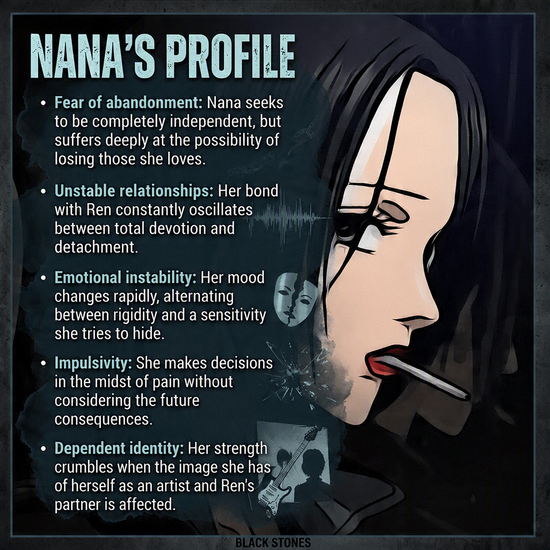
Based on the criteria examined here, Nana Osaki clearly shows five of them: fear of abandonment hidden behind her independence, unstable relationships, mood changes connected to the people she loves, impulsive reactions to emotional pain, and an identity built around another person.
This suggests strong compatibility with borderline personality disorder within the story Nana Osaki experiences. However, it is important to remember that this is an interpretation of a fictional character, based only on what the story chooses to show. There may be details, dialogue, and reactions that viewers or readers do not notice, or that the story never reveals.
A real diagnosis is never based only on behavior observed from a distance. It requires multiple appointments, detailed interviews, a careful review of the person’s life history, and an understanding of what lies behind each behavior. No fictional story can provide all of that information.
For this reason, what we see here is only one part of Nana, not the whole person.
Even so, this emotional depth is what keeps Nana from seeming perfect and makes her feel human to the audience. This analysis remains an interpretation of the series NANA. Its purpose is to help us understand the depth of the emotions she carries within her story, not to establish a final conclusion about her mental health.
NANA OSAKI AND THE OTHER LAYERS BEHIND HER STRENGTH
In addition to the aspects connected to borderline personality disorder, Nana’s behavior may also suggest other difficulties that could occur alongside it.
The way she deals with loss and separation throughout the story brings to mind some symptoms associated with post-traumatic stress disorder. Experiences of abandonment during childhood can leave lasting wounds that resurface when later situations trigger the same original pain.
At certain points in the story, there are also signs that may be consistent with depression, particularly when Nana withdraws and shows an emotional exhaustion that seems to go beyond a temporary rough patch.
When several difficulties occur at the same time, Nana’s behavior becomes even more complex. That is why she deserves careful consideration rather than quick labels.
WHAT NANA OSAKI’S STORY CAN TEACH US ABOUT LOVING WITHOUT LOSING OURSELVES
If you recognized yourself in any of these experiences, that does not say anything negative about your worth as a person. Loving intensely and fearing the loss of someone you love do not make you a bad or broken person. They show that you feel deeply.
Borderline personality disorder is real. Recognizing some of its traits in yourself, even through a fictional character, can be the first step toward seeking professional help. Improvement is possible, and many people achieve greater stability and balance through therapy and appropriate support.
Many people find support by following my Instagram profile, @myborderlineview, where I share content that helps people better understand this disorder in everyday life.
You can also take a look at my original material. It includes deeper reflections on the subject and may help you explore it further. Visit the e-book My Borderline View.
IF YOU HAVE NOT WATCHED THE ANIME YET
It is worth following Nana Osaki’s journey from this new perspective. Pay attention to her silences, changes in behavior, and the moments when her strength gives way to vulnerability. Then draw your own conclusions about this memorable character.
WHAT REMAINS AFTER THE MUSIC STOPS
At first glance, Nana Osaki’s intensity, along with the way she loves, fears, and reacts, may look like nothing more than a strong personality. However, it can also hide signs that are easy to miss without careful attention.
Understanding borderline personality disorder more clearly can help people who live with it seek the right support. Recognizing some of these traits, even through a fictional character, can be an important step in that direction.
No matter where you are right now, improvement is possible. Many people experience remission of their symptoms when they commit to therapy and receive appropriate support.
THE END!
2. ALICE AYRES, OR JANE JONES, FROM CLOSER: BPD OR JUST TRAITS?
Disclaimer: this text includes major spoilers about the character, including how the film ends.
Who is Alice Ayres, or Jane Jones?

Who is Alice Ayres
Alice Ayres is a character from the 2004 film Closer, played by Natalie Portman. She’s American, and we first meet her alone on the streets of London, right after she gets hit by a car. That accident is where her story in the city kicks off. She works as a stripper at a nightclub and spends four years in an intense, on-and-off relationship.
Alice Ayres isn’t her real name. She picked it up from a memorial plaque in a London park, honoring a young woman who died saving three kids from a fire back in the 1800s. That’s the name she chose to go by, though she never fully explains why.
Only near the end do we see a close-up of her passport, which reveals her real name: Jane Jones. During those four years living as Alice, she told the truth about her identity exactly once, but the person she told didn’t believe her. Before London, she’d left the U.S. shortly after another relationship ended, and that pattern repeats throughout her whole story: she’s always the one who leaves, always the one who decides when something’s over, always the one who starts fresh somewhere new under a different name.
People often link Alice to Borderline Personality Disorder because of how mysterious she is about her past, how intensely she attaches to the people she loves, and how strongly she reacts when her relationships get shaky. Characters like her, full of contradictions and layers that don’t get resolved in one scene, invite you to think, not to slap a label on someone.
What was Alice’s past like?
The film never shows Alice‘s childhood or spells out what she went through before showing up in London. We know she left the U.S. right after a relationship ended, and that same pattern plays out every time another relationship starts falling apart: she bails before getting dumped.
Was there some kind of breakup or loss that made her keep starting over, far from everything she knew? The way she dodges talking about where she comes from suggests yes, even though we never get concrete details about what happened before that relationship back in the U.S.
Alice feels everything hard. The highs of new connections and the lows of betrayal both hit extremes, no middle ground, like each emotion completely takes over while it’s happening.
She also acts on impulse when things hurt, taking off without warning, letting people in or shutting them out in a heartbeat. And through it all, there’s this sense that she’s looking for something bigger than the relationship itself in each person she’s with, some kind of anchor in a life she’s chosen to keep up in the air.
Characteristics of Borderline Personality Disorder in Alice
Some behavior patterns stand out strong in this character’s arc.
- Fear of abandonment. Alice latches on hard to whoever she’s with from day one and reacts intensely to any hint they might pull away, even bracing for rejection before it actually happens.
- Identity disturbance. She’s living under a name that isn’t hers, building a version of herself to show the world, while her real story stays locked away and mostly unknown, even to people close to her.
- Emotional instability. Alice‘s reactions shift fast, swinging from light, affectionate moments to explosions of pain and anger the second something threatens the relationship she’s poured so much into.
- Feelings of emptiness. Behind the confident front Alice puts on in public, there’s this recurring sense that something’s missing, hinted at by how she looks to other people for meaning that never quite sticks.
- Impulsivity in moments of suffering. When pain hits, Alice makes snap decisions with no planning, like taking jobs that put her out there or vanishing without a word to the people she leaves behind.
Does Alice actually have BPD or is it just traits?
When you line up the fear of abandonment, identity disturbance, emotional instability, feelings of emptiness, and impulsivity when things hurt, Alice checks off enough boxes to point to strong compatibility with Borderline Personality Disorder, at least based on what the story shows us.
That doesn’t mean Alice, or Jane, actually has the disorder, though. We’re working with one possible read based on what the script chose to reveal, and scripts always cut, pick, and leave stuff out. A real diagnosis takes multiple conversations over time with a qualified pro, careful interviews, and a full rundown of someone’s life history, something no movie can fully deliver in just over a hundred minutes.
What sticks with you is exactly that depth that makes Alice Ayres, or Jane Jones, so memorable in Closer. It’s the mix of mystery, intensity, and vulnerability that makes her such a standout character, and maybe that’s why so many people see themselves, even in pieces, in what she goes through on screen.
Other possible conditions
Beyond BPD traits, some of Alice‘s behaviors might also point to other related issues, always as possibilities, never as certainties.
The way she handles her own story, hiding facts and dodging trips down memory lane, could hint at signs of post-traumatic stress disorder, especially if something big happened before the film starts and we never see it.
The swing between bursts of intense energy and stretches of deep sadness might also suggest traits of depression, which show up in several spots during the second half of the story as losses pile up.
The habit of keeping emotional distance and calling it quits before risking getting dumped could also point to traits of avoidant personality disorder, since Alice seems to prefer controlling when each story ends rather than sitting with the uncertainty of waiting for it.
It’s worth remembering these conditions often overlap in real life, and spotting a trait doesn’t mean you’ve got the whole picture. Everyone’s different, and the point here is to open space for understanding, not labeling.
What Alice and Jane’s story might say about your own life
If something in this analysis clicked for you, it’s worth taking a minute to sit with that.
Spotting real traits of Borderline Personality Disorder in yourself says nothing about your worth as a person. These are patterns that build over a lifetime, often in response to tough experiences, not a final verdict on who you are.
The good news is there’s a real path forward. With support from a qualified therapist, you can get a better handle on your own feelings, deal with them in healthier ways, and find more stability over time. Therapy is that path, and reaching out for help makes a real difference.
If you want to keep this conversation going, I’m also over on Instagram at @myborderlineview, talking about this stuff almost daily. And for anyone who wants to dig deeper, I’ve put together everything I’ve learned over the years in the e-book My Borderline View, available for anyone interested.
Worth watching the story
If you haven’t seen Closer yet, it’s worth a watch. Take your time and form your own take on Alice, or Jane, and the road she travels to the end of the film. Everyone sees something different in this journey, and that’s exactly what makes watching it so interesting.
Every intensity deserves to be looked at closely
The emotional intensity Alice, or Jane, carries through Closer can be an invitation to notice similar feelings in your own life, if they’re there. Getting a better grasp on what Borderline Personality Disorder is helps you find the right support at the right time. Spotting traits, even first in a fictional character, can be the first step on a longer road. And that road, with therapy and time, usually leads to real improvement, with more stability and more peace day to day.
The End!
3. DAENERYS TARGARYEN FROM GAME OF THRONES: DOES SHE REALLY SHOW BORDERLINE PERSONALITY DISORDER TRAITS OR JUST SOME FEATURES?
Heads up, this text reveals important parts of Daenerys’s journey in Game of Thrones.
Who Is Daenerys Targaryen?

Daenerys is born as the last member of a overthrown dynasty, and that condition marks the entire first half of her story. Since she’s a valuable piece in her brother’s plan to reclaim the family throne, she spends much of Game of Thrones being used in other people’s decisions: first her brother decides for her, then comes an arranged marriage, then a war she never chose to fight alone. What changes, gradually, is how she reacts to all this stuff that happens to her rather than because of her.
That reaction is exactly what grabs attention. Daenerys can go from being a liberator full of ideals to a ruler willing to do anything to not lose what she’s conquered, without any comfortable middle ground between these two versions of herself. It’s this back and forth, more than the story itself, that makes part of the audience associate Daenerys with Borderline Personality Disorder (BPD).
What Was Daenerys’s Past Like?
Before any conquests, Daenerys grew up without having a say in her own decisions, always depending on someone else’s will to know where she’d live or who she’d marry.
This helps explain why, later on, she reacts so strongly to any sign of losing control. Someone who spent their whole life being decided by others tends to hold tighter onto what’s finally theirs.
You can also notice that Daenerys feels everything more intensely than the people around her. Joy, gratitude, and anger almost always show up in strong versions, rarely moderate.
BPD Characteristics in Daenerys
Looking at Daenerys’s behavior, some criteria of Borderline Personality Disorder appear consistently, without needing to force the interpretation.
- Intense fear of abandonment. Whenever she feels someone close might drift away from her, even after a serious betrayal, Daenerys tends to forgive too quickly, because losing another person seems worse than taking back someone who already disappointed her once.
- Unstable relationships, with idealization and devaluation. People she trusts usually get treated as perfect while they meet her expectations, and start being viewed with distrust or distance as soon as they disagree with any of her decisions.
- Emotional instability. Within the same short period, Daenerys can act with genuine generosity and, right after, with a harshness that seems to belong to a completely different person.
- Intense anger that’s hard to control. When she feels her own authority is threatened, her response usually comes fast and too strong for the actual size of the threat.
- Paranoid symptoms under stress. In moments of high pressure, Daenerys starts seeing risk in almost everyone around her, including people who always stood by her side.
So Does Daenerys Actually Have BPD Or Just Traits?
All together, Daenerys shows five criteria of Borderline Personality Disorder pretty clearly: fear of abandonment, relationships marked by idealization and devaluation, emotional instability, hard-to-contain anger, and paranoid symptoms under extreme stress. This points to high compatibility with the disorder within the story told by Game of Thrones.
Keep in mind this reading comes only from what the series chose to show on screen. A real diagnosis of Borderline Personality Disorder requires professional support across multiple sessions, careful interviews, and a complete analysis of the person’s life history, something no work of fiction fully delivers.
That same intensity is one of the reasons Daenerys remains one of the most discussed characters in Game of Thrones to this day. The difficulty finding middle ground between generosity and violence is what gives this character so much power.
Other Conditions That Might Also Be Present in Daenerys
Besides Borderline Personality Disorder, Daenerys’s journey suggests the presence of other conditions that often walk hand in hand with that picture.
The buildup of wars, betrayals, and violent losses points to signs of Post-Traumatic Stress Disorder (PTSD), since she stays in a state of alert practically nonstop, always waiting for the next attack.
You can also spot traits that come close to Narcissistic Personality Disorder, mainly in how she needs to be seen as the just ruler everywhere she goes, reacting intensely whenever that recognition doesn’t come the way she expects.
These conditions don’t replace the Borderline Personality Disorder reading, but they can overlap with it, making Daenerys’s behavior even harder to sum up in one explanation.
When Losing Control Feels Like The Only Way Out
If you recognize yourself in the actual criteria of Borderline Personality Disorder that show up here, remember this doesn’t define who you are. Feeling everything at higher intensity, fearing abandonment, or reacting with anger when situations threaten what you’ve built doesn’t make you a worse person, just someone who hasn’t had the chance to deal with this the right way yet.
Getting better is possible, and seeking therapy is usually the first step to understand these reactions and create more stable ways to handle them day to day.
Many people find support by following my Instagram profile, @myborderlineview, where I share content aimed at those living with Borderline Personality Disorder.
I also leave there the e-book My Borderline View, which brings deeper reflections on the subject for anyone who wants to go beyond what was discussed here.
If You Haven’t Watched The Series Yet
It’s worth checking out Game of Thrones with this closer look at Daenerys’s journey. Watch for the moments of fragility that appear between the big battles and draw your own conclusions about this heavily discussed character.
Recognize Before Judging
Daenerys’s emotional intensity, along with her difficulty trusting and her anger when facing threats, shows that Borderline Personality Disorder carries signs that often go unnoticed, both in fiction and in real life. Understanding this disorder more precisely helps those living with it find the right support at the right time.
Recognizing traits in yourself, even from a character’s story, can be the first step toward getting real help. And with therapy and proper support, symptom remission is possible, no matter how hard the situation might seem right now.
The End!
4. PEARL, FROM PEARL (2022), DOES SHE REALLY SHOW SIGNS OF BORDERLINE PERSONALITY DISORDER OR IS IT JUST TRAITS?
Heads up: this text reveals important parts of the plot of Pearl (2022).
Who Is Pearl?
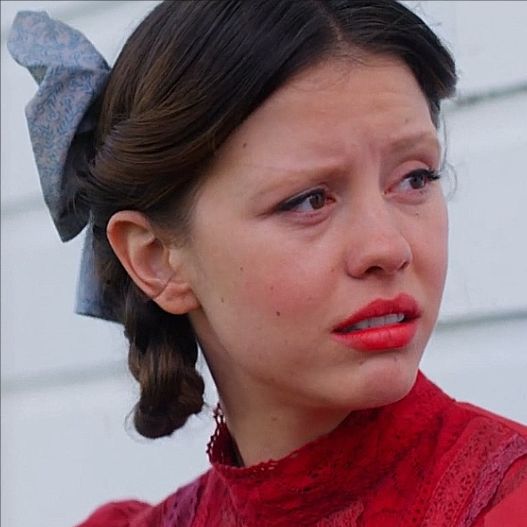
Pearl lives on an isolated farm in Texas in 1918, married to a husband who’s far away, fighting in the war. At home, all she has is the company of an extremely strict mother and a paralyzed father, whom she has to take care of every day all by herself.
Her only escape is the movie theater in town, where she watches films that make her dream of becoming a real dancer and star. That dream of leaving the farm and being seen by someone, somewhere, is what drives pretty much every decision she makes throughout the story.
When that dream starts running into rejections and people who threaten to mess up her plan, Pearl reacts in a disproportionate way and sometimes even violently.
What Was Pearl’s Past Like?
Pearl’s routine is marked by her mother’s constant watchfulness, controlling what she wears, where she goes, and even how long she can spend outside the house.
There’s no space within that routine for Pearl to express who she really is or what she feels, so that desire to be seen ends up bottled up for years.
It’s also possible to notice that whenever someone shows up offering attention or the possibility of a different life, Pearl clings to that person with an intensity that leaves no room for middle ground.
BPD Characteristics in Pearl
Looking at Pearl’s behavior throughout the story, some criteria of Borderline Personality Disorder (BPD) show up pretty clearly.
- Intense fear of abandonment. As soon as she feels someone is about to leave her, whether it’s her distant husband in the war or someone she just met, Pearl’s reaction is immediate and out of control, as if any departure confirms she’ll never be enough for anyone.
- Unstable relationships, with idealization and devaluation. The person who catches Pearl’s interest is treated at first as the key to the whole life she always wanted, but as soon as that same person decides to go their own way, they become an obstacle to be eliminated.
- Chronic feeling of emptiness. The constant need to be noticed, applauded, and loved by someone on some stage shows a person who never felt complete within their own routine, no matter how much they try to fill that with fantasies of fame.
- Emotional instability. Pearl can dance alone, smiling, full of hope, and minutes later act with completely different coldness toward anything that threatens that hope.
- Intense anger that’s hard to control. Faced with rejection or an argument at home, Pearl’s response usually comes fast and way too violent for what actually happened.
Does Pearl Actually Have BPD or Is It Just Traits?
All in all, Pearl shows five criteria of Borderline Personality Disorder pretty clearly: fear of abandonment, relationships marked by idealization and devaluation, chronic emptiness, emotional instability, and anger that’s hard to contain. This points to high compatibility with the disorder within the story told in Pearl.
It’s worth remembering that this reading comes only from what the movie shows on screen, in a short slice of her life. A real diagnosis of Borderline Personality Disorder requires professional follow-up over several sessions, careful interviews, and a complete analysis of the person’s life story, something no work of fiction fully delivers.
Still, that intensity is one of the reasons that makes Pearl one of the most talked-about characters in recent horror. The gap between what she dreams of and what life actually offers her is what gives this story so much power.
Other Conditions That Might Also Be Present in Pearl
Besides Borderline Personality Disorder, Pearl’s behavior suggests the presence of other conditions that often walk hand in hand with this picture.
The constant need to be at the center of attention, with emotional reactions that are pretty exaggerated for any audience, comes close to Histrionic Personality Disorder, always tied to the search for recognition and applause.
The coldness with which she commits acts of violence, without apparent guilt afterward, also points to traits of Antisocial Personality Disorder, present in people who act without considering the harm they cause to others.
These conditions don’t replace the reading of Borderline Personality Disorder, but they tend to overlap with it, making Pearl’s behavior even harder to sum up in just one explanation.
BPD Characteristics and You
If you recognize yourself in the real criteria of Borderline Personality Disorder that show up here, it’s worth remembering that this doesn’t define who you are. Feeling everything with greater intensity, fearing abandonment, or reacting with anger toward situations that threaten what you’ve built doesn’t make you a worse person, just someone who hasn’t yet had the chance to deal with this the right way.
Getting better is possible, and seeking therapy is usually the first step to understanding these reactions and creating more stable ways of handling them day to day.
Many people find support by following my Instagram profile, @myborderlineview, where I share content aimed at those living with Borderline Personality Disorder.
I also leave there the e-book My Borderline View, which brings deeper reflections on the subject for anyone who wants to go beyond what was discussed here.
The Price of Never Feeling Enough
Pearl’s emotional intensity, along with her difficulty accepting rejection and her anger in the face of frustrations, shows that Borderline Personality Disorder carries signs that often go unnoticed, both in fiction and in real life. Understanding this disorder more precisely helps those living with it to seek the right support at the right time.
Recognizing traits in yourself, even from a character’s story, can be the first step toward seeking real help. And with therapy and proper support, symptom remission is possible, no matter how hard the situation might seem right now.
The End!
5. DOES BELLA SWAN FROM TWILIGHT: THE SAGA REALLY SHOW SIGNS OF BORDERLINE PERSONALITY DISORDER?
A quick note before we begin: if you have not watched the entire saga yet, this article contains major spoilers.
Rain tapped against the car window as the girl stared at the gray city outside. She felt that her new home was a sacrifice she had made to give her mother the freedom she wanted. Deep inside, she carried a painful emptiness and the constant fear that she did not belong anywhere.
When Bella Swan traded the sunshine of Phoenix for the fog of Forks in Twilight: The Saga, she began an intense emotional journey. This article contains brief spoilers from the movies and invites you to look beyond the fantasy romance. The goal is to examine the behaviors shown on screen with empathy and clarity.
WHO IS BELLA SWAN?

Bella Swan is the quiet protagonist who moves in with her father in an isolated town. Raised by an unpredictable mother, she learned early on to take on the role of the responsible one. She pushed her own needs aside to keep some sense of balance in the relationship.
At her new school, she attracts the attention of several boys, but her focus shifts when she meets Edward Cullen. The mysterious teenager hides the fact that he is a vampire and draws Bella into an all-consuming relationship. The line between loving someone and losing yourself begins to disappear.
The story moves forward through devastating breakups, including the abandonment in New Moon. Edward’s absence plunges Bella into deep despair and leaves her emotionally frozen. To secure an eternal bond, she chooses constant danger and eventually agrees to undergo a physical transformation.
Fans connect Bella to borderline personality disorder because her pain over separation is so intense that it spills beyond the screen. She is portrayed as someone whose emotional stability depends almost entirely on the presence of the person she loves. That complete surrender shapes nearly every step of her journey throughout the movies.
WHAT WAS BELLA SWAN’S PAST LIKE?
Bella’s cinematic backstory is shaped by her relationship with an unpredictable mother. Constant changes and uncertainty forced her to become the mature one in the family. That reversal of roles left deep insecurities in the way she formed emotional bonds.
She learned early that love meant putting herself aside and staying alert for signs of abandonment. From the moment she arrives in Forks, she seems weighed down by a lasting exhaustion with life. No school routine can fully ease the loneliness she carries inside.
Bella also shows a strong tendency to place her entire sense of worth in being close to the person she loves. That search for emotional refuge shapes the way she relates to the world. Her past helps explain how emotional dependence became such a central part of her relationships.
SIGNS OF BORDERLINE PERSONALITY DISORDER IN BELLA SWAN
- Intense efforts to avoid abandonment: when Edward decides to leave her in the forest, Bella falls into complete despair. She puts her own life at risk and seeks out dangerous situations just to hear his voice again.
- Unstable and intense relationships, with idealization and devaluation: their relationship is portrayed in extremes. Bella moves from complete devotion to overwhelming pain when Edward’s absence destroys her sense of security.
- Emotional instability, with rapid and intense mood changes: her emotions swing from a subdued melancholy to severe emotional crises. She experiences uncontrollable crying, panic, and deep confusion when faced with conflict.
- Chronic feelings of emptiness: from the beginning, Bella appears deeply disconnected from the human world around her. She feels detached until she finds an intensity among the vampires that seems to fill the emptiness inside her.
- Self-destructive impulsivity: in an attempt to feel close to Edward again, Bella rides motorcycles with strangers. She also jumps from cliffs, putting her life at risk and showing little concern for her own physical safety.
SO, DOES BELLA SWAN HAVE BPD, OR DOES SHE ONLY SHOW SOME OF ITS TRAITS?
Five criteria can be observed consistently throughout the story, suggesting a strong resemblance to borderline personality disorder. Even so, this is an interpretation of a fictional character’s behavior. Keeping that distinction clear matters because it prevents rushed conclusions and inaccurate labels.
Recognizing certain patterns in a fictional character can be a starting point for understanding something about yourself. However, this kind of analysis can never replace the evaluation of a qualified mental health professional in relation to a real person’s life. Movies can serve as a mirror, but only a clinical professional can make a diagnosis.
BELLA, AN INTENSITY THAT PUSHES THE LIMITS OF SELF
Bella’s experience with emotional pain connects closely with the difficulties associated with emotional dysregulation. Her periods of deep sadness appear during the months she spends sitting in silence and staring out the window. That prolonged grief reveals a depressive state made worse by loss.
There are also moments when she seems disconnected from what is happening around her, which may be understood as signs of depersonalization. Under extreme stress, the mind can distance itself from reality as a way to cope with overwhelming pain. Her body reaches its limits while she struggles to process emotions that feel impossible to contain.
WHEN INTENSE FEELINGS FIND A SAFER PATH
Seeing yourself in stories of extreme pain and unconditional attachment can bring old feelings of loneliness to the surface. Living with intense emotions does not mean that your story has to end in suffering. Consistent professional support can change the way you build and experience relationships.
Many people who have stayed committed to therapy have found a level of stability that once seemed impossible. They learned how to feel at home in their own bodies without needing another person to be their only source of support. If you would like to continue reflecting on these topics and share your experiences, follow the posts on @myborderlineview.
To explore your self-awareness journey further, take a look at the complete material in the e-book My Borderline View. This resource can support people who want to understand their emotions more clearly. Greater clarity begins when we give a voice to what we have kept inside for too long.
IF YOU HAVE NOT WATCHED THE MOVIES YET
The movies in Twilight: The Saga are worth watching if you want to take in their atmosphere of isolation. The performances create an overwhelming romance that leaves room for you to form your own conclusions. Pay attention to the small details in the visual storytelling as the story unfolds.
THE END BEGINS WITH TAKING CARE OF YOURSELF
Strong emotional reactions can be a sign that a situation deserves closer attention and a different kind of support. Understanding borderline personality disorder more accurately can help people who live with it seek appropriate care. Building relationships in which love does not require you to lose yourself is an important step toward freedom.
Recognizing certain traits in yourself can be the beginning of change. That awareness can encourage you to seek help and turn emotional pain into self-understanding. Improvement is possible for people who pursue therapy and want to live with greater stability, wholeness, and peace.
THE END!
Disclaimer
6. DOES SHINJI IKARI FROM NEON GENESIS EVANGELION REALLY SHOW SIGNS OF BORDERLINE PERSONALITY DISORDER, OR JUST SOME BORDERLINE TRAITS?
Warning: This article contains major spoilers for Neon Genesis Evangelion.
Who Is Shinji Ikari?

One question follows Shinji from the beginning of the story to the end: why keep going when being close to people hurts just as much as being away from them? He agrees to pilot a weapon of war, driven less by courage than by the hope that his own father will finally tell him he did the right thing.
People willing to get close to him gradually enter his life, including classmates, a guardian, and other pilots. Still, Shinji treats every attempt at closeness as something too dangerous to last. He wants companionship, but he also protects himself from it all the time, as if trusting someone were more dangerous than being alone.
Many viewers recognize something similar to borderline personality disorder in this pattern of behavior, especially in the way Shinji never seems to find a comfortable place between needing other people and being afraid of them. Shinji is the main character of the franchise and pilots Evangelion.
What Was Shinji’s Childhood Like?
Shinji’s mother dies in an accident connected to her work when he is still very young. Not long afterward, his father leaves him in someone else’s care and disappears from his life for years without offering any explanation.
Growing up this way teaches Shinji to expect very little from the people who are supposed to take care of him. He also begins to associate asking for affection with the risk of being pushed aside once again.
When someone eventually shows genuine interest in him later in the story, his reaction is never simple. Relief comes mixed with suspicion and the fear that this person will leave too, just as everyone else has.
Signs of BPD in Shinji
When some of Shinji’s behavior is examined closely, it lines up with several of the criteria commonly used to describe borderline personality disorder:
- Intense fear of abandonment. Even after being ignored by his own father for years, Shinji keeps trying to please him because the possibility of being rejected again weighs more heavily than all the hurt he has already carried.
- Unstable sense of identity. Outside his role as a pilot, Shinji struggles to explain who he is or what he wants from life, as if his entire sense of worth depended on being useful to someone else.
- Unstable relationships marked by idealization and devaluation. He quickly becomes attached to people who show sincere interest in him, then just as quickly shuts down or pulls away at the slightest sign of rejection, even when that sign is minor.
- Chronic feelings of emptiness. The belief that he has no value without someone else’s approval keeps coming back, including during moments when he has already proven his own worth through his actions.
- Emotional instability. Long periods of silence and withdrawal can suddenly turn into episodes of crying or despair when he faces situations that other people might handle without suffering as intensely.
So, Does Shinji Have BPD or Just Some Borderline Traits?
Five signs commonly associated with borderline personality disorder are clearly present in Shinji’s behavior: fear of abandonment, an unstable sense of identity, relationships shaped by idealization and devaluation, chronic feelings of emptiness, and emotional instability. Within the story told by Neon Genesis Evangelion, this suggests a strong resemblance to the disorder.
It is important to remember that this interpretation is based only on what the show presents. A real diagnosis requires sessions with a mental health professional, careful interviews, and an assessment of the person’s entire life history, which a fictional story cannot provide.
Even so, the way Shinji’s vulnerability is presented so openly is one of the reasons he remains one of the most remembered and discussed characters in anime, decades after the series first premiered.
Other Conditions That May Also Be Present in Shinji
Shinji’s behavior also allows for other interpretations, since some conditions can occur alongside borderline personality disorder.
The accumulation of loss and the constant pressure he faces from a very young age may point to signs of post-traumatic stress disorder, especially in the almost constant state of alertness in which he lives.
His lack of energy, isolation, and feeling that nothing he does is ever enough may also suggest depression.
These interpretations do not rule out borderline traits. They can exist at the same time, and that combination is what makes Shinji so difficult to place in a single category.
When Asking for Help Feels Riskier Than Staying Silent
You may have recognized something of yourself in this story. If the real criteria associated with borderline personality disorder described here felt familiar, remember that they do not define who you are or determine your worth.
Reacting intensely, fearing abandonment, or choosing silence to avoid another disappointment are struggles that can improve with the right support. Therapy is often an important first step.
Many people find support by following my Instagram profile, @myborderlineview, where I share content for people living with borderline personality disorder.
You can also take a look at my original e-book, e-book My Borderline View, which offers deeper reflections on the disorder.
If You Haven’t Watched It Yet
It is worth watching Neon Genesis Evangelion while paying as much attention to Shinji’s silences as you do to his battles. Those quiet moments reveal much of what shapes the character, and you can draw your own conclusions.
Being Seen Without Having to Prove Anything
Shinji’s story shows how borderline personality disorder can hide behind a quiet personality, without shouting or dramatic scenes, and therefore go unnoticed for a long time. Understanding these signs more clearly can help people living with them seek support before their suffering becomes even harder to manage.
Recognizing part of yourself in a fictional character’s story can be the beginning of a real search for help. With therapy and proper support, remission of symptoms is possible, no matter how far away it may seem right now.
THE END!
7. KEVIN PEARSON FROM THIS IS US: DOES HE REALLY SHOW SIGNS OF BORDERLINE PERSONALITY DISORDER OR IS IT JUST TRAITS?
Heads up, this text reveals important parts of the This Is Us plot.
Who Is Kevin Pearson?

Kevin Pearson
Kevin grows up as the good-looking son, the one who always grabs attention just by walking into a room. A knee injury ends his dream of playing football while he’s still young, and that’s when acting shows up as a new path, a way to keep being noticed.
Success comes fast, but it comes through a shallow role in a sitcom, and that bothers Kevin more than he lets on. He wants to be taken seriously, wants to be loved for what he does and not just for how he looks, and that inner pressure sticks with him through pretty much every career decision he makes after that.
In his personal life, the pattern repeats. He gets in and out of the same relationship with Sophie, his first love, multiple times over the years, always convinced that this time it’ll be different. It’s that cycle of starting over, messing everything up, and trying again that makes part of the audience see borderline personality disorder (BPD) traits in Kevin.
What Was Kevin’s Past Like?
While still a teenager, Kevin loses his father suddenly, in a tragedy right inside the family’s own home. He deals with that loss by trying to act tough way too soon, without giving himself room to actually process the grief.
While his siblings each find their own ways to handle that pain, Kevin spends years avoiding the subject, hiding what he feels behind an easy smile and the image of someone who’s doing fine.
Later on, a new physical problem brings him back to prescription meds, and that’s when it becomes clear just how much he never really had the tools to deal with pain, whether physical or emotional.
BPD Characteristics in Kevin
Looking at Kevin’s behavior throughout the series, some criteria for borderline personality disorder (BPD) show up in a pretty recognizable way.
- Intense fear of abandonment. Kevin tends to hold on to the relationships that matter most to him even after he’s already messed everything up on his own, because the idea of losing that person for good weighs heavier than the pride of admitting his own mistake.
- Unstable relationships, with idealization and devaluation. His relationship with Sophie follows a script that keeps repeating: reconciliation, hope, disappointment, and pulling away, with neither of them able to find a steady middle ground for long.
- Identity disturbance. Kevin spends much of his adult life trying to figure out who he is outside of the role of “the good-looking one in the family,” and that constant search for professional recognition shows just how much his own sense of worth never felt secure to him.
- Self-destructive impulsivity. His use of alcohol and painkillers, plus quick decisions about career and relationships made in the heat of the moment, show a pattern of acting before thinking through the consequences.
- Chronic feelings of emptiness. Even surrounded by success, attention, and people who love him, Kevin carries a constant sense that something’s missing, like nothing is quite enough to fill what he feels inside.
So Does Kevin Actually Have BPD Or Is It Just Traits?
All in all, Kevin shows five criteria for borderline personality disorder (BPD) pretty clearly: fear of abandonment, relationships marked by idealization and devaluation, identity disturbance, self-destructive impulsivity, and chronic feelings of emptiness. Within the story told by This Is Us, that points to a strong match with the disorder.
That conclusion, though, comes only from what the This Is Us series showed us. Locking in a real diagnosis depends on ongoing professional care, careful interviews, and a full look at the person’s life history, something no work of fiction can pull off.
Either way, it’s that mix of charm and hidden pain that makes Kevin one of the most memorable characters in This Is Us, precisely because he seems so sure of himself and so lost inside at the same time.
Other Conditions That Might Also Be Present in Kevin
Kevin’s behavior also hints at other conditions that often show up alongside borderline personality disorder (BPD).
His repeated use of alcohol and prescription meds as a way to cope with physical and emotional pain points to signs of Substance Use Disorder, a pattern that, in the series, gets worse right in the moments of highest personal pressure.
The constant feeling of emptiness, even during phases of apparent success, also brings to mind signs of Persistent Depressive Disorder, seen in his trouble holding on to a sense of well-being for long.
None of these conditions replaces the reading of borderline personality disorder (BPD). They walk together, and it’s that mix that makes Kevin such a hard character to sum up in one line.
When Being Loved for Your Looks Isn’t Enough
If the real criteria for borderline personality disorder (BPD) described here sounded familiar, it’s worth remembering that they don’t define your worth as a person. Repeating patterns, fearing abandonment, or feeling like something’s missing even when everything seems fine are signs that something needs attention, not a reason to judge yourself.
Getting better is possible, and seeking therapy is usually the first real step toward understanding those patterns and building steadier ways to handle them day to day.
A lot of people find support by following my profile on Instagram, @myborderlineview, where I share content aimed at folks living with borderline personality disorder (BPD).
I also leave over there the e-book My Borderline View, which brings deeper reflections on the subject for anyone who wants to go beyond what was discussed here.
If You Haven’t Watched It Yet
It’s worth checking out This Is Us while paying attention to the moments when Kevin is alone, with no audience to please. That’s where the series shows much of what really shapes this character, and it’s up to you to draw your own conclusions about it.
Needing Applause to Feel Real
Kevin’s story shows how borderline personality disorder (BPD) can hide behind charm, success, and a life that looks like it doesn’t have big problems, which often delays the moment when someone seeks help. Understanding this disorder more precisely helps those living with it recognize it sooner.
Recognizing traits in yourself, even from a character’s story, can be the first step toward getting real help. And, with the right therapy and support, symptom remission is possible, no matter how tough things seem right now.
The End!
WANDA MAXIMOFF: THE SCARLET WITCH OF THE MARVEL UNIVERSE, DOES SHE REALLY DEMONSTRATE TRAITS OF BORDERLINE PERSONALITY DISORDER OR JUST TRAITS?
By adminborderline / September 25, 2026
Attention: this text reveals important parts of Wanda Maximoff‘s journey, the Scarlet Witch of the Marvel Universe.
Who is Wanda Maximoff?

Wanda Maximoff gains her powers through a risky experiment, accepted far more out of a desire for revenge than for any other reason. From that point on, her path becomes a string of losses that never seem to let up: the boyfriend she loves, her twin brother, and finally the very idea of a normal life.
When she finally seems to have everything she ever wanted, she loses it all again, and that loss drives her to create, using her own powers, an entire reality just for herself, where she can keep alive the life she never had. The problem is that this reality doesn’t exist on its own, it’s built on top of real people, trapped there with no choice.
It’s that blurry line between what Wanda feels she deserves and what she’s willing to do to get it that makes part of the audience see traits of Borderline Personality Disorder (BPD) in her.
What was Wanda’s past like?
As a child, Wanda loses her parents in an explosion inside their own home, and spends days next to her twin brother, trapped in the rubble beside an artifact that could explode at any moment.
Growing up knowing that your own home can turn dangerous, and that losing someone can happen in the blink of an eye, leaves marks that show up later in how she reacts to any threat of loss.
It’s also worth noting that whenever she finally finds some stability, whether in a cause, a person, or a place, Wanda clings to that bit of security with a force that goes beyond any reasonable limit.
BPD traits in Wanda
Looking at Wanda‘s journey throughout her story in the movies, several criteria for Borderline Personality Disorder show up pretty clearly.
- Intense fear of abandonment. After repeatedly losing the people she loves most, Wanda reacts to any sign of new loss as if it were unbearable, which leads her to try to recreate, by force, what’s already gone.
- Identity disturbance. Throughout the story, she goes from war victim to trained weapon, from heroine to housewife in a fabricated reality, and finally to a figure feared by her own allies, never managing to hold on for long to who she really wants to be.
- Emotional instability. Wanda swings between moments of genuine tenderness, especially with those she loves, and outbursts of uncontrolled power as soon as she feels threatened or betrayed by that same person.
- Self-destructive impulsivity. The decision to keep an entire town trapped inside an illusion, even as she gradually understands the harm it’s causing to the real people inside, shows just how much she acts first and deals with the consequences later.
- Intense anger that’s hard to control. Faced with any obstacle between her and what she wants to recover, Wanda‘s response tends to come fast and out of proportion, even turning against those who were once allies.
- Dissociative symptoms under stress. In moments of extreme pain, Wanda goes as far as building entire realities to escape what she’s feeling, losing, even if temporarily, the sense of what’s real and what’s just wishful thinking.
So does Wanda actually have BPD or is it just traits?
All in all, Wanda displays six criteria for Borderline Personality Disorder quite clearly: fear of abandonment, identity disturbance, emotional instability, self-destructive impulsivity, hard-to-control anger, and dissociative symptoms under stress. Within Wanda Maximoff‘s journey, the Scarlet Witch of the Marvel Universe, this represents a high level of alignment with the disorder.
This conclusion, though, comes only from what those productions chose to show on screen. Reaching a real diagnosis depends on ongoing professional care, careful interviews, and a full look into the person’s life history, something no work of fiction can replicate.
Still, it’s exactly that mix of immense power and emotional fragility that makes Wanda one of the most talked-about characters in the genre, especially for showing how unresolved pain can grow into something far bigger than itself.
Other conditions that might also be present in Wanda
Wanda‘s journey also points to other conditions, which often go hand in hand with Borderline Personality Disorder.
The grief that never gets processed in a healthy way, piling up over years and successive losses, points to signs of Prolonged Grief Disorder, seen in her refusal to accept the permanent absence of those who are gone.
The trauma experienced in childhood, marked by violence and a constant sense of danger, also brings to mind signs of Post-Traumatic Stress Disorder (PTSD).
None of these conditions replaces the reading of Borderline Personality Disorder. They coexist, and it’s that mix that makes Wanda‘s behavior so hard to sum up in just one explanation.
When grief turns into a world of its own
If the real criteria for Borderline Personality Disorder described here sounded familiar, it’s worth remembering that they don’t define your worth as a person. Fearing abandonment, feeling everything too intensely, or holding on tight to the little stability you’ve gained are signs that something needs attention, not a reason to judge yourself.
Getting better is possible, and seeking therapy is usually the first real step toward understanding these patterns and finding more stable ways to deal with them day to day.
Many people find support by following my Instagram profile, @myborderlineview, where I share content aimed at those living with Borderline Personality Disorder.
I also leave there the e-book My Borderline View, which brings deeper reflections on the subject for anyone who wants to go beyond what was discussed here.
If you haven’t watched it yet
It’s worth following Wanda Maximoff‘s journey while paying attention to what lies behind each display of power. Notice the moments of silence and pain between one battle and another, and draw your own conclusions about this much-talked-about character.
Continuing to love those who are no longer here
Wanda‘s story shows how Borderline Personality Disorder can come from real losses, piled up over a lifetime, and how the difficulty of dealing with them can turn into something bigger and bigger when it doesn’t find the right support. Understanding this disorder more precisely helps those living with it to seek help before the suffering piles up even more.
Recognizing traits in yourself, even from a character’s story, can be the first step toward getting real help. And, with therapy and the right support, symptom remission is possible, no matter how hard things might seem right now.
The End!
9. MIMA KIRIGOE FROM PERFECT BLUE: DOES SHE REALLY SHOW SIGNS OF BORDERLINE PERSONALITY DISORDER, OR JUST CERTAIN TRAITS?
This article contains important plot details from Perfect Blue.
WHO IS MIMA KIRIGOE?

Mima leaves the music group she used to sing with to pursue an acting career, a decision that does not sit well with everyone. Some of her fans feel betrayed, while one particular fan cannot accept the change at all.
In an effort to establish herself as a serious actress, she takes on increasingly demanding roles that are far removed from the sweet image she had built as a singer. Around the same time, she discovers a website describing her daily life in intimate detail, including things no one else should know. It is as if someone is keeping a diary while pretending to be her.
Caught between the pressure of her new career and this constant invasion of her privacy, Mima begins to lose her sense of what is real and what may be a confused memory or a nightmare. This gradual feeling that her identity is falling apart is what leads some viewers to see borderline traits in her character.
WHAT WAS MIMA’S PAST LIKE?
The story does not reveal much about Mima’s childhood, so the safest focus is the most recent period of her life, shortly after she leaves the music group.
During this time, she has to deal with the pressure of proving herself in a new environment, the hostility of people who refuse to accept her decision, and the constant feeling that someone is watching her, even inside her own home.
All of this tension builds up quickly, until she begins to question her own memory. She can no longer tell for certain whether particular scenes really happened or were only dreams.
SIGNS OF BPD IN MIMA
When Mima’s behavior is examined throughout the story, several features associated with borderline personality disorder, or BPD, stand out:
- Identity disturbance: Mima begins to see an earlier version of herself, the singer she used to be, as if that version were more real than she is. She even starts questioning which version is the real Mima.
- Dissociative symptoms under stress: As the pressure builds, Mima experiences memory gaps and begins confusing scenes from her acting roles with events that may have happened in real life. She can no longer separate them with confidence.
- Emotional instability: In public, Mima tries to remain composed and keep up with her routine. Internally, however, she shifts between panic, guilt, and a level of exhaustion that feels impossible to carry.
- Chronic feelings of emptiness: After giving up her identity as a singer without fully establishing herself as an actress, Mima begins to feel that she does not belong anywhere. It is as if she has lost one part of herself without gaining another in its place.
- Idealization and devaluation directed at herself: Mima divides her identity into two opposing sides, with no middle ground between them. The singer she used to be is treated as the good and authentic version of herself, while the actress she is trying to become is viewed as an impostor who must be destroyed.
DOES MIMA HAVE BPD, OR DOES SHE ONLY SHOW SOME TRAITS?
Mima clearly displays five features associated with borderline personality disorder: identity disturbance, dissociative symptoms under stress, emotional instability, chronic feelings of emptiness, and a split between idealization and devaluation directed toward her own identity. Within the story told in Perfect Blue, these traits suggest a strong resemblance to the disorder.
Still, this interpretation is based only on what the movie shows during a short and extremely intense period of her life. A real diagnosis requires ongoing professional care, detailed interviews, and a complete understanding of a person’s history. No fictional story can reproduce that entire process.
Even so, Mima’s gradual loss of her sense of identity is what makes her one of the most analyzed characters in animated film. Her story captures, with unusual precision, what it can feel like to lose your sense of who you are.
OTHER CONDITIONS THAT MAY ALSO BE PRESENT IN MIMA
Mima’s behavior may also suggest other conditions that can occur alongside BPD.
Her difficulty distinguishing reality from imagination, especially under pressure, may point to symptoms associated with depersonalization-derealization disorder, which involves feeling detached from yourself or experiencing the world around you as strange or unreal.
The constant pursuit by an obsessed fan, combined with the threats and the exposure of her private life, may also resemble symptoms associated with post-traumatic stress disorder.
These possibilities do not replace an interpretation based on borderline personality disorder. More than one condition can exist at the same time, and this combination is part of what makes Mima’s behavior so difficult to explain with a single label.
WHEN YOU NO LONGER KNOW WHICH VERSION OF YOURSELF IS REAL
If the descriptions of BPD discussed here felt familiar, remember that they do not define your worth as a person. Feeling unsure of your identity, doubting yourself under pressure, or carrying a constant sense of emptiness does not mean you are broken. It may mean that you need the right support to deal with what you are going through.
Improvement is possible, and starting therapy can be an important step toward understanding these patterns and finding more stable ways to handle them in everyday life.
Many people find support by following my Instagram profile, @myborderlineview, where I share content for people living with borderline personality disorder.
I also share the e-book My Borderline View, which offers deeper reflections on the subject for anyone who wants to understand it more fully.
IF YOU HAVE NOT WATCHED THE MOVIE YET
Perfect Blue is worth watching with attention to the way it plays with the audience’s perception, just as much as it plays with Mima’s. You can draw your own conclusions about what is real and what may be the result of all the pressure she is under.
LEARNING TO TRUST WHAT YOU FEEL AGAIN
Mima’s story shows that BPD can affect the way a person sees themselves, not only the way they relate to other people. A more accurate understanding of the disorder can help people who live with it recognize certain signs before their distress becomes even harder to manage.
Recognizing some of these traits in yourself, even through the story of a fictional character, can be the first step toward seeking professional help. With therapy and proper support, remission of symptoms is possible, no matter how difficult the situation may seem right now.
THE END!
This text is strictly an educational analysis of fictional characters based on how they behave in their stories. The goal is to bring clarity to Borderline Personality Disorder, helping people who relate to it recognize patterns, reflect more safely, and feel encouraged to start therapy with a qualified professional. No part of this article should be taken as absolute truth, nor does it serve as a diagnosis, clinical evaluation, or medical opinion.